4 Ways To Get Rid Of Grub Worms In Your Lawn
Eliminate grub worms damaging your lawn with proven control methods. Learn to identify grubs, treat infestations naturally and chemically, and prevent future damage.
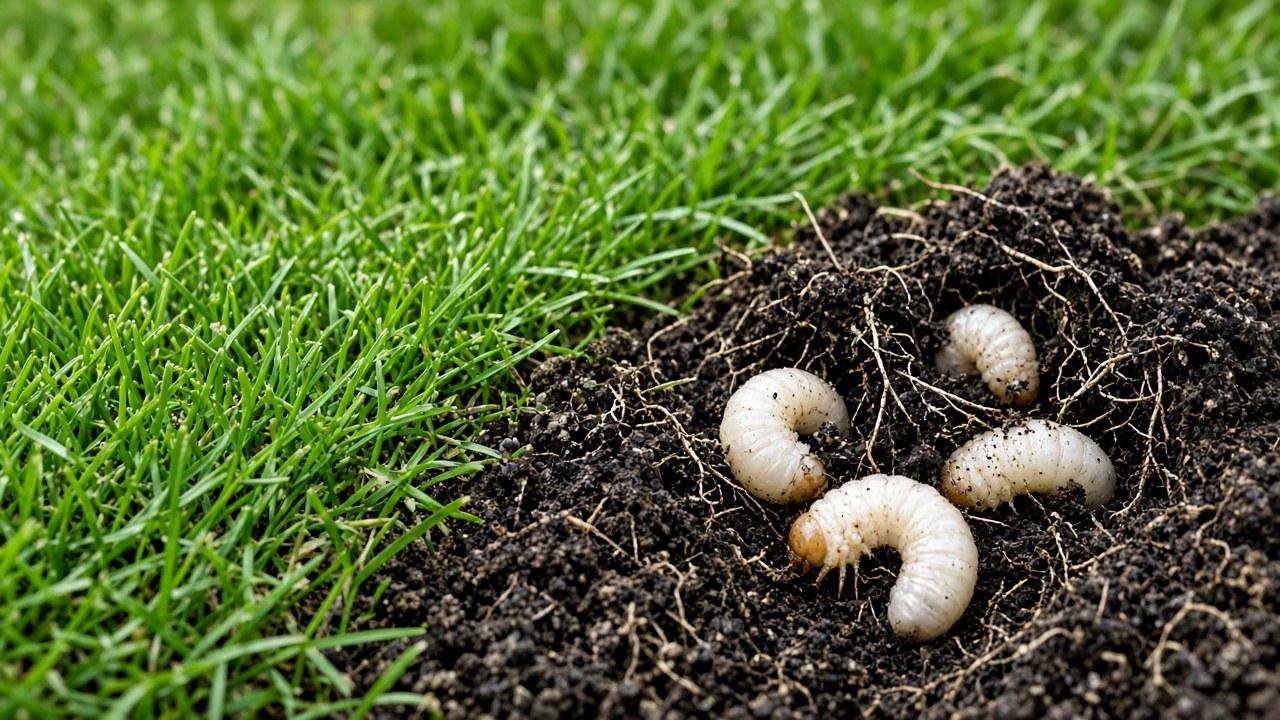
Grub worms are one of the most destructive lawn pests in North America. These C-shaped white larvae feed on grass roots below the soil surface, causing brown patches that peel away like carpet. Left unchecked, a grub infestation can destroy an entire lawn in a single season. Here’s how to identify, treat, and prevent grub damage effectively.
What Are Grub Worms?
Grub worms are the larval stage of various beetle species that complete their life cycle in your lawn.
Common grub species:
- Japanese beetles: Most common and destructive; white grubs with brown heads, 3/4 to 1 inch long
- June beetles (May/June bugs): Larger grubs (up to 1.5 inches), slower feeders
- European chafers: Similar to Japanese beetle grubs but slightly smaller
- Masked chafers: Smaller grubs, less damaging but still problematic
- Oriental beetles: Smaller grubs, prefer sandy soils
Life cycle:
- Summer (June-August): Adult beetles emerge, mate, and lay eggs in soil
- Late summer-fall (August-October): Eggs hatch; young grubs feed aggressively on grass roots
- Winter: Grubs burrow deep (6-12 inches) to avoid freezing
- Spring (April-May): Grubs move back to root zone, feed briefly before pupating
- Early summer: Pupae transform into adult beetles; cycle repeats
Why grubs damage lawns:
- Feed exclusively on grass roots in the top 2-3 inches of soil
- Sever roots from grass blades
- Grass can’t absorb water or nutrients
- Damage appears as brown, dead patches
- Turf lifts away easily (no root anchoring)
Identifying Grub Damage
Recognizing grub damage early allows for effective treatment.
Visual symptoms:
- Irregular brown patches: Dead or dying grass in random areas (not drought patterns)
- Spongy turf: Lawn feels soft and spongy when walked on
- Turf rolls back: Grass peels away like carpet or sod (no root resistance)
- Increased bird activity: Crows, starlings, and robins digging for grubs
- Animal damage: Skunks, raccoons, and armadillos tearing up lawn to feed on grubs
- Timing: Damage most visible late summer through fall
How to confirm grubs:
- Dig a test section: Cut three sides of a 1-foot square of turf
- Peel back sod: Lift turf and examine soil surface
- Count grubs: Look for white, C-shaped larvae with brown heads
- Check multiple spots: Test 3-4 areas in damaged and healthy zones
Threshold levels (grubs per square foot):
- 0-4 grubs: Normal population; no treatment needed
- 5-9 grubs: Moderate infestation; monitor closely
- 10+ grubs: Heavy infestation; treatment required
- 15+ grubs: Severe damage imminent; treat immediately
Time of year considerations:
- Late summer/early fall (August-October): Best time to find grubs; they’re feeding near surface
- Late spring (April-May): Grubs active but about to pupate (treatment less effective)
- Winter: Grubs deep underground (impossible to find or treat)
Method 1: Beneficial Nematodes (Organic Treatment)
Microscopic roundworms that parasitize and kill grubs naturally.
What are beneficial nematodes?:
- Microscopic worms (invisible to naked eye)
- Species used: Heterorhabditis bacteriophora (Hb) and Steinernema carpocapsae (Sc)
- Hunt grubs in soil, enter their bodies, release bacteria
- Bacteria multiply and kill grub within 24-48 hours
- Nematode reproduces inside dead grub, releases thousands more
- Cycle continues until grubs eliminated
Effectiveness:
- Japanese beetle grubs: 80-90% control with Hb strain
- June beetle grubs: 60-80% control
- European chafers: 70-85% control
- Works best on young grubs (early instars)
When to apply:
- Best timing: Late summer to early fall (August-September)
- Soil temperature 50-90°F (nematodes die outside this range)
- Apply when grubs are small and actively feeding near surface
- Can also apply in late spring if you missed fall window
How to apply beneficial nematodes:
-
Purchase fresh nematodes:
- Buy from reputable suppliers (check expiration date)
- Store refrigerated until use (don’t freeze)
- Use within 2-3 weeks of purchase
- Common brands: NaturesGoodGuys, Arbico Organics, Grub Grenade
-
Prepare application area:
- Mow lawn to 2-3 inches
- Water lawn thoroughly day before (soil must be moist)
- Apply in evening or on cloudy day (UV light kills nematodes)
-
Mix nematodes:
- Follow package directions for dilution ratio
- Use unchlorinated water (chlorine kills nematodes; let tap water sit 24 hours)
- Mix gently (don’t use high-pressure sprayer)
- Water temperature 40-90°F
-
Apply with sprayer:
- Use hose-end sprayer, backpack sprayer, or watering can
- Remove any filters (nematodes clog fine mesh)
- Spray evenly across affected areas
- Keep mixture agitated (nematodes settle quickly)
- Apply 50 million nematodes per 1,000-1,500 sq ft
-
Water in immediately:
- Irrigate with 1/2 inch water immediately after application
- Nematodes must reach soil (can’t survive on grass blades)
- Keep soil moist for 2 weeks after application
- Light watering daily helps nematodes move through soil
Pros:
- Completely safe for people, pets, and beneficial insects
- No chemical residue
- Can be used on edible gardens nearby
- Self-replicating (some nematodes persist year to year)
Cons:
- More expensive than chemical treatments ($50-100 for 5,000 sq ft)
- Requires precise timing and soil conditions
- Less effective than chemicals on heavy infestations
- Must be applied correctly (many failures due to improper application)
- Short shelf life (must use fresh)
Method 2: Milky Spore (Long-Term Biological Control)
A naturally occurring soil bacterium that specifically targets Japanese beetle grubs.
What is milky spore?:
- Paenibacillus popilliae (formerly Bacillus popilliae)
- Bacterial disease fatal only to Japanese beetle grubs
- Grub ingests spores while feeding
- Bacteria multiply in grub’s blood, turn it milky white
- Grub dies; body releases millions more spores into soil
- Spores persist for 15-20 years once established
Effectiveness:
- Japanese beetle grubs only: 75-95% control (highly specific)
- No effect on: June bugs, chafers, or other grub species
- Takes 1-3 years to establish fully
- Provides long-term suppression (decades)
When to apply:
- Best timing: Late summer through fall (August-November)
- Can apply spring or early summer if needed
- Soil temperature above 65°F (bacteria won’t establish in cold soil)
- Grubs must be actively feeding
How to apply milky spore:
-
Determine application method:
- Powder form: St. Gabriel Organics Milky Spore (most common)
- Granular form: Some brands offer spreader-ready granules
-
Powder application (traditional method):
- Apply 1 teaspoon per spot in grid pattern
- Space spots 4 feet apart in all directions
- Covers about 2,500-3,000 sq ft per 10 oz container
- Use drop spreader or apply by hand
-
Grid pattern layout:
- Mark lawn in 4 ft x 4 ft grid
- Drop 1 teaspoon powder at each intersection
- Water in lightly (1/4 inch irrigation)
- Powder washes into soil and establishes
-
Watering requirements:
- Water immediately after application
- Keep soil moist for 2-3 weeks
- Requires moisture to activate bacteria
-
Repeat applications (optional but recommended):
- Apply second treatment 3 months after first
- Third application 3 months later
- Increases speed of establishment
Pros:
- Lasts 15-20+ years once established
- Completely safe for all non-target organisms
- No reapplication needed after establishment
- No mixing or equipment required
- Can be applied any time during growing season
Cons:
- Only works on Japanese beetle grubs (useless for other species)
- Slow to establish (1-3 years for full effect)
- Expensive upfront ($40-80 per 5,000 sq ft)
- Doesn’t work in cold climates (requires soil temp 65°F+)
- Must have Japanese beetle grubs present to establish
- Not effective for immediate control
Method 3: Chemical Grub Control (Fast-Acting Treatment)
Synthetic insecticides provide rapid knockdown of heavy infestations.
Active ingredients and products:
Curative treatments (kill existing grubs):
Trichlorfon (Dylox):
- Speed: Kills grubs in 24-48 hours
- Best for: Emergency treatment of severe damage
- When to apply: August-October when damage visible
- Effectiveness: 90-95% control of all grub species
- Reapplication: Can reapply after 3 weeks if needed
- Safety: Moderate toxicity; keep pets off 24 hours
Carbaryl (Sevin):
- Speed: Kills in 3-7 days
- Best for: Late-season treatment
- When to apply: Late summer through fall
- Effectiveness: 75-85% control
- Reapplication: Can reapply after 7-10 days
- Safety: Higher toxicity to bees; apply in evening
Preventive treatments (kill newly hatched grubs):
Imidacloprid (Merit, GrubEx):
- Speed: Systemic; provides season-long control
- Best for: Preventing damage in lawns with grub history
- When to apply: Late spring to early summer (May-July)
- Effectiveness: 90-95% control if applied before eggs hatch
- Duration: 3-4 months of protection
- Safety: Low toxicity once watered in
Clothianidin (Arena):
- Speed: Slow-acting systemic
- Best for: Preventing Japanese beetle and June bug grubs
- When to apply: Spring or early summer
- Effectiveness: 85-95% control
- Duration: Full season protection
- Safety: Low toxicity after watering
Chlorantraniliprole (Acelepryn):
- Speed: Reduced-risk chemical with long residual
- Best for: Turf managers; professional-grade product
- When to apply: Spring through midsummer
- Effectiveness: 90-100% control of all grub species
- Duration: 4-6 months
- Safety: Very low toxicity; safe around water
Application instructions:
-
Choose correct product:
- Curative (Dylox, Sevin): Use when damage is visible now
- Preventive (imidacloprid, clothianidin): Use before eggs hatch
-
Calibrate spreader:
- Use drop spreader or rotary spreader
- Follow product label for spreader settings
- Most products applied at 2-4 lbs per 1,000 sq ft
-
Apply evenly:
- Mow lawn first
- Apply in two directions (half rate each way for even coverage)
- Overlap slightly to avoid streaks
-
Water in immediately:
- Irrigate with 1/4 to 1/2 inch water right after application
- Essential for moving insecticide into root zone
- Grubs must ingest treated soil/roots to die
-
Safety precautions:
- Keep children and pets off treated area until dry
- Don’t apply before heavy rain (prevents runoff)
- Avoid contaminating waterways
- Wear gloves during application
- Store products in original containers
Pros:
- Fast, reliable control (especially curative treatments)
- Works on all grub species
- Cost-effective ($20-40 per 5,000 sq ft)
- Widely available at garden centers
- Easy to apply with standard spreader
Cons:
- Toxic to bees and aquatic organisms
- Environmental concerns (especially neonicotinoids)
- Kills beneficial soil insects
- Potential groundwater contamination
- Annual reapplication often needed
- Some products banned in certain regions
Method 4: Cultural and Mechanical Controls
Non-chemical practices that reduce grub populations and damage.
Proper lawn care practices:
Healthy, vigorous turf resists grub damage:
- Fertilize appropriately: 3-4 lbs nitrogen per 1,000 sq ft annually (makes grass more resilient)
- Mow at proper height: 3-4 inches for cool-season grasses (deeper roots tolerate grub feeding)
- Water deeply, infrequently: Encourages deep roots that survive moderate grub feeding
- Overseed thin areas: Thick turf crowds out beetle egg-laying sites
- Aerate compacted soil: Improves root growth and water penetration
Withhold irrigation in summer (strategic approach):
- Adult beetles prefer laying eggs in moist, irrigated lawns
- Reducing irrigation in July-August makes lawn less attractive
- Newly hatched grubs need moist soil to survive
- Drought-stressed conditions kill many young grubs
- Caution: Only practical in regions where some drought tolerance is acceptable
Biological and mechanical controls:
Encourage natural predators:
- Birds: Robins, starlings, crows feed heavily on grubs
- Install bird feeders and baths
- Allow birds to forage on lawn (they indicate grub presence)
- Beneficial insects: Ground beetles, rove beetles eat grub eggs and small larvae
- Maintain mulched bed borders (beetle habitat)
- Reduce pesticide use
- Parasitic wasps: Tiphia wasps parasitize Japanese beetle grubs
- Plant flowering ground covers (wasp nectar sources)
Physical removal (for small areas):
- Dig up affected turf sections
- Hand-pick visible grubs from soil
- Destroy grubs (drop in soapy water)
- Replace turf or reseed
- Only practical: For small gardens, flower beds, or spot damage
Row covers and barriers:
- Cover vulnerable turf areas with landscape fabric in June-July (prevents egg-laying)
- Not practical for large lawns but works for small areas
Landscape choices:
Plant less attractive grass species:
- Tall fescue: Coarser texture; less preferred by beetles
- Fine fescue: Tolerates shade; less beetle activity in shade
- Perennial ryegrass: Recovers quickly from moderate grub damage
- Avoid: Kentucky bluegrass in grub-prone areas (highly attractive to beetles)
Replace lawn with alternatives (grub-prone sites):
- Ground covers (clover, thyme, sedum)
- Mulched beds
- Hardscaping (patios, gravel)
- Native plants requiring no irrigation
Timing considerations for reseeding:
- Fall overseeding: Best time in grub-prone lawns (grubs moving deep for winter)
- Spring seeding: Risky if grubs still present (wait until after treatment)
Integrated Grub Management Strategy
Combine methods for best long-term control.
Year 1 (Immediate control):
- Late summer: Confirm grub presence (dig test squares)
- If 10+ grubs/sq ft: Apply curative chemical (Dylox) for fast knockdown
- If 5-9 grubs/sq ft: Apply beneficial nematodes
- Repair damage: Overseed bare patches in fall
Year 2 (Transition to biological):
- Early summer: Apply milky spore powder (if Japanese beetles confirmed)
- Mid-summer: Monitor for adult beetles; note egg-laying activity
- Late summer: Apply beneficial nematodes as preventive measure
- Fall: Aerate and overseed to thicken turf
Year 3+ (Maintenance):
- Spring: Monitor for grub damage from overwintering larvae
- Summer: Continue milky spore establishment (reapply if needed)
- Fall: Check grub populations (should be declining)
- Ongoing: Maintain healthy turf with proper fertilization and mowing
Decision matrix:
| Grub Count | Grass Damage | Recommended Action |
|---|---|---|
| 0-4 per sq ft | None | No treatment needed |
| 5-9 per sq ft | Minimal | Beneficial nematodes |
| 10-14 per sq ft | Moderate | Chemical curative or nematodes |
| 15+ per sq ft | Severe | Chemical curative (Dylox) immediately |
Preventing Future Grub Damage
Proactive measures reduce recurring infestations.
Adult beetle control:
- Hand-pick beetles: Remove Japanese beetles from roses, grapes, other host plants daily
- Beetle traps: Controversial (may attract more beetles than they kill)
- If used, place traps 100+ feet away from lawn
- Empty daily
- Use pheromone lures sparingly
- Spray adults: Treat ornamental plants with insecticides to kill egg-laying females (reduces lawn grub populations)
Reduce egg-laying habitat:
- Delay irrigation: Don’t water lawn in June-July (beetles prefer moist soil for eggs)
- Choose drought-tolerant grasses: Beetles avoid dry lawns
- Eliminate beetle food sources: Japanese beetles feed on 300+ plant species
- Remove or net particularly attractive plants (roses, grapes, linden trees)
- Reduces adult beetle populations in your yard
Monitor yearly:
- June-July: Watch for adult beetles emerging
- August-September: Check for grubs (dig test squares)
- October: Confirm success of treatments
- April-May: Check for spring grub activity before pupation
Regional considerations:
- Northern states: One generation per year; treat late summer only
- Southern states: Two generations possible; treat late spring and fall
- Coastal areas: June bugs more common than Japanese beetles
Neighborhood collaboration:
- Grub control most effective when entire neighborhood treats
- Adult beetles fly 1-5 miles from emergence sites
- Coordinate with neighbors for area-wide suppression
For more information on lawn health and maintenance, see our lawn care basics guide.
The Bottom Line
Grub worms cause extensive lawn damage by feeding on grass roots, but effective control options exist for every situation and preference. For organic control, apply beneficial nematodes (Heterorhabditis bacteriophora) in late summer when grubs are small and actively feeding — this provides 80-90% control of Japanese beetle grubs with no chemical residue. For long-term suppression of Japanese beetles specifically, milky spore establishes a permanent population of grub-killing bacteria that persists for 15-20 years.
Chemical treatments offer faster results: curative products like Dylox kill existing grubs within 24-48 hours when damage is already visible, while preventive treatments like imidacloprid applied in early summer stop newly hatched grubs before they cause damage. The best strategy combines methods: treat heavy infestations chemically for immediate relief, then transition to biological controls for sustainable long-term management.
Confirm grub populations before treating by digging 1-foot square test sections — 10 or more grubs per square foot requires treatment, while fewer than 5 grubs rarely cause visible damage. Healthy, well-maintained turf with proper fertilization, deep watering, and 3-4 inch mowing height tolerates moderate grub populations better than stressed lawns. For comprehensive pest management strategies, see our common garden pests guide.