How to Get Rid of Bindii: Complete Australian Control Guide
Eliminate bindii weeds from your lawn with proven cultural and chemical control methods. Learn to identify bindii (jo-jo), understand its lifecycle, and prevent future infestations.
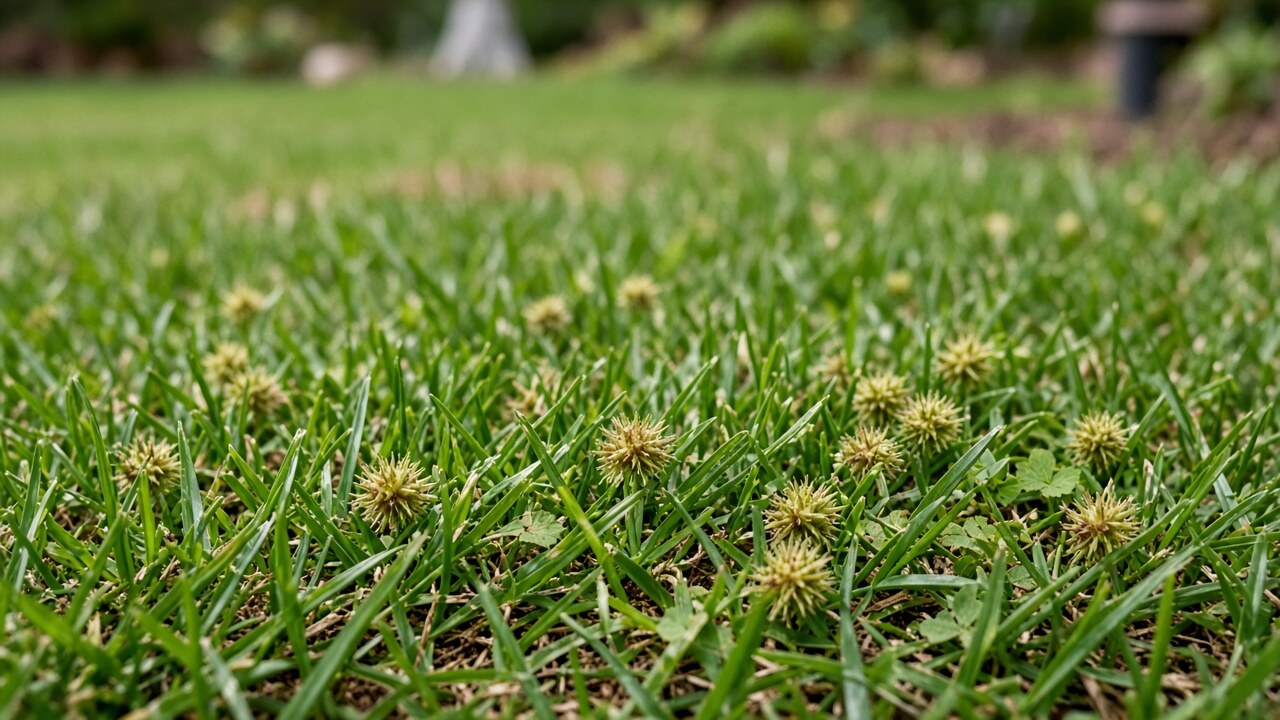
Bindii (Soliva sessilis), also called jo-jo or onehunga weed, is one of Australia’s most hated lawn weeds. Those tiny, painful seed burrs that stick to bare feet and pet paws in spring make bindii public enemy number one for Australian lawns. But with the right timing and techniques, you can eliminate bindii and prevent it from returning.
What Is Bindii?
Bindii is a low-growing annual broadleaf weed native to South America that has spread throughout Australia. It thrives in lawns from tropical Queensland to temperate Tasmania.
Identifying bindii
Appearance:
- Rosette growth: Spreads flat against the ground in a circular pattern
- Leaves: Finely divided, feathery, carrot-like leaves
- Size: Individual plants spread 5-20 cm diameter
- Colour: Bright to dark green
- Seeds: Sharp, spiky burrs that mature in late spring
Similar weeds: Bindii is sometimes confused with common lawn weeds, but the feathery leaves and painful seed burrs are distinctive.
Bindii lifecycle in Australia
Understanding bindii’s annual cycle is the key to effective control:
Autumn (March-May):
- Bindii seeds germinate after autumn rains and cooler temperatures
- Tiny seedlings establish and begin growing
Winter (June-August):
- Rosettes grow larger and spread
- Plants remain low to avoid mower blades
- This is the BEST time for control (see below)
Spring (September-November):
- Rapid growth and flowering
- Seed burrs form and harden
- By late spring, painful burrs are everywhere
- Plants begin to die off as weather warms
Summer (December-February):
- Plants die back completely in heat
- Seeds remain dormant in soil
- Bare patches where bindii died create opportunities for more weeds
Why Bindii Thrives in Australian Lawns
Bindii loves the same conditions that stress many lawn grasses:
Thin, weak turf: Gaps in grass coverage allow bindii to establish. Healthy, dense lawns naturally crowd out bindii seedlings.
Poor soil fertility: Bindii tolerates low-fertility soils where grass struggles.
Compaction: Hard, compacted soil reduces grass vigour but doesn’t bother bindii.
Low mowing height: Scalped lawns expose soil to light, helping bindii seeds germinate. Bindii rosettes grow flat beneath mower blades.
Dry conditions: Bindii has moderate drought tolerance and often outcompetes stressed lawn grasses during dry winters.
The solution? Improve lawn health to naturally suppress bindii while using targeted controls to eliminate existing plants.
Best Time to Control Bindii
Late winter to early spring (August-early September) is the optimal window for bindii control in most of Australia. Here’s why:
Why winter control works:
- Bindii plants are actively growing and vulnerable to herbicides
- Seed burrs haven’t formed yet (no painful bare feet)
- Grass damage from herbicides is minimal (grass is semi-dormant)
- Single treatment catches entire population before seeding
Why spring control is less effective:
- Plants are larger and harder to kill
- Seeds may already be forming
- Requires multiple treatments
- More risk of herbicide damage to warm-season grasses as they green up
Why autumn control doesn’t work:
- Bindii seedlings are tiny and hard to spot
- Many haven’t germinated yet
- You’ll miss the majority of the population
Mark your calendar for August. This is your bindii control window.
Non-Chemical Bindii Control
Cultural and mechanical methods reduce bindii without herbicides. These approaches work best for small infestations or as part of a long-term prevention strategy.
Hand weeding
Practical for very small areas (under 5 m²) or isolated plants.
How to hand weed bindii:
- Weed in late winter before seed burrs form
- Water lawn day before weeding (easier to pull from moist soil)
- Use a weeding fork or knife to lift the entire root system
- Wear gloves to protect hands from any early burrs
- Bag and bin pulled weeds (don’t compost)
Challenges: Tedious for large infestations. Easy to leave root fragments that regrow.
Improve lawn density
The single most effective long-term bindii prevention strategy is growing thick, healthy turf.
How thick grass suppresses bindii:
- Dense grass shades soil, preventing bindii seed germination
- Vigorous grass outcompetes bindii seedlings for water, nutrients, and light
- Thick turf physically crowds out new weeds
How to thicken your lawn:
- Mow at correct height: Keep buffalo at 3-5 cm, kikuyu at 2-3 cm, couch at 1.5-2.5 cm. Never scalp.
- Fertilise regularly: 3-4 applications annually (see your grass type’s fertiliser needs)
- Water deeply: 1-2 times weekly to encourage deep roots
- Aerate compacted soil: Hollow-tine aeration in spring
- Top-dress bare patches: Fill thin areas with soil and overseed if appropriate
For detailed lawn care practices, see our lawn care basics guide.
Pre-emergent herbicides
Pre-emergent herbicides prevent bindii seeds from germinating. Apply in early-mid autumn (March-April) before seeds germinate.
Products:
- Oxafert Plus (oxadiazon)
- Bow and Arrow (pendimethalin)
How to use:
- Apply to moist soil in early autumn
- Water in lightly after application
- Forms a chemical barrier in top layer of soil
- Prevents bindii (and other weed) seeds from germinating
Limitations:
- Timing is critical (too late and seeds have already germinated)
- Won’t kill existing bindii
- Temporary effect (needs annual reapplication)
- Can prevent grass seed germination if overseeding
Chemical Bindii Control
Selective herbicides kill bindii while leaving lawn grasses unharmed. This is the most effective method for established bindii infestations.
Best herbicides for bindii
Selective broadleaf herbicides containing one or more of these active ingredients:
Bromoxynil (fast-acting contact herbicide):
- Kills bindii on contact
- Works best on young, actively growing plants
- Visible results in 1-3 days
MCPA (systemic herbicide):
- Absorbed through leaves and roots
- Kills entire plant including root system
- Slower but more thorough than bromoxynil
Dicamba (systemic herbicide):
- Very effective on stubborn weeds
- Works well on bindii rosettes
- Slower action (7-14 days)
Recommended products:
- Amgrow Bin-Die: Specifically formulated for bindii, contains bromoxynil
- Munns Professional Bindii & Clover Weeder: Bromoxynil + MCPA
- Yates Buffalo PRO Weed ‘n’ Feed: Herbicide + fertiliser combo (buffalo-safe)
- Scotts Lawn Builder + Bindii Killer: Fertiliser + MCPA (buffalo-safe)
How to apply bindii herbicide
Timing: Late winter to early spring (August-early September) for best results.
Conditions:
- Apply on a calm day (wind under 10 km/h)
- Air temperature 15-25°C ideal
- Apply to dry grass (no rain forecast for 24 hours)
- Avoid during heat waves or when frost is expected
Application:
-
Mow 2-3 days before spraying: Allows regrowth for better herbicide absorption, but keeps plants small enough for spray coverage
-
Mix herbicide according to label directions: Most products are concentrated and need dilution (don’t guess — measure accurately)
-
Apply evenly: Use a pump sprayer or hose-end applicator to cover entire lawn or spot-treat affected areas
-
Wetting agent: Add a wetting agent (surfactant) if recommended on label — helps herbicide spread and penetrate waxy leaf surfaces
-
Don’t oversaturate: Apply until leaves are wet but not dripping
-
Keep pets and kids off: Until spray dries (usually 1-2 hours)
Follow-up:
- Don’t mow for 3-4 days after spraying (allows herbicide absorption)
- Water lightly if lawn shows stress
- Inspect lawn 2 weeks after treatment
- Spot-treat survivors with second application if needed
Buffalo grass herbicide safety
Critical warning: Many common lawn herbicides damage or kill buffalo grass.
NEVER use these on buffalo grass:
- Anything containing 2,4-D
- Products labelled “not for use on buffalo”
Buffalo-safe options:
- Products specifically labelled “safe for buffalo”
- Bromoxynil-based products (Amgrow Bin-Die)
- Spot treatments (careful application minimises risk)
If you have buffalo grass, read labels carefully and choose buffalo-safe formulations. When in doubt, spot-test on a small, inconspicuous area first.
Spot spraying vs blanket application
Spot spraying (treating individual bindii plants):
- More economical (less herbicide used)
- Reduced chemical exposure
- Practical for light infestations
- Better for buffalo lawns (reduces risk)
Blanket application (spraying entire lawn):
- More convenient for heavy infestations
- Catches every plant
- Often combined with fertiliser (weed ‘n’ feed products)
Choose based on infestation severity and grass type.
Preventing Bindii From Returning
Killing existing bindii is only half the battle. Prevention stops new infestations.
Long-term prevention strategies
1. Maintain lawn density: Thick grass is bindii’s nemesis. See lawn improvement section above.
2. Apply pre-emergent herbicide annually: In early-mid autumn to prevent seed germination.
3. Monitor and spot-treat early: Inspect lawn in winter. Hand-pull or spot-spray any bindii rosettes immediately.
4. Avoid scalping: Set mower to correct height for your grass type. Scalping exposes soil to light and encourages weed germination.
5. Fertilise appropriately: Healthy, well-fed grass outcompetes weeds naturally. Apply slow-release fertiliser 3-4 times per year.
6. Top-dress bare patches: Fill thin areas with quality lawn soil. Bare soil invites bindii.
7. Water correctly: Deep, infrequent watering (1-2 times weekly) encourages deep grass roots and drought tolerance. See our lawn watering guide.
Dealing with neighbouring bindii
Bindii seeds blow in from neighbouring properties, nature strips, and parks. Even a perfect lawn can suffer reinfestation from nearby sources.
What to do:
- Politely mention bindii to neighbours (they probably hate it too)
- Contact council about nature strips and public spaces
- Use pre-emergent herbicides as a defensive barrier
- Accept that occasional bindii is normal and manageable
Bindii in Different Australian Climates
Bindii adapts to most Australian climates but timing varies:
Temperate zones (Sydney, Melbourne, Adelaide, Perth):
- Germinates in autumn (March-May)
- Control window: August-early September
- Standard control methods effective
Subtropical zones (Brisbane, Gold Coast):
- Germinates slightly earlier (late summer-early autumn)
- Control window: July-August
- Warmer winters = longer growth period
Tropical zones (Darwin, far north QLD):
- Less common due to year-round heat
- Where present, germinates in dry season (May-July)
- Control window: August-September
Cool temperate (Canberra, Tasmania, alpine regions):
- Germinates in autumn after frosts end
- Control window: September (later than warmer zones)
- Slower growth due to cooler temperatures
Adjust timing based on local conditions. The rule of thumb: Spray in late winter when bindii rosettes are visible but before seed burrs form.
Other Common Lawn Weeds
Once you’ve conquered bindii, you might notice other weeds in your lawn:
Crabgrass: Another summer annual that invades thin turf. See our guide to getting rid of crabgrass.
Clover: Nitrogen-fixing broadleaf that some homeowners tolerate (soft, green, drought-tolerant). Controlled with same herbicides as bindii.
Dandelions: Deep-rooted perennial controlled with systemic herbicides.
Oxalis (sourgrass): Persistent weed requiring repeated treatments.
All these weeds share a common theme: they thrive in weak, thin lawns. Improve lawn health and weed pressure naturally decreases.
Professional Bindii Control
Most homeowners can control bindii themselves, but professional lawn care services offer:
- Correct herbicide selection for your grass type
- Precise application with commercial equipment
- Integrated programs combining herbicides, fertiliser, and lawn improvement
- Ongoing monitoring and follow-up treatments
Mowing Magic provides professional weed control, fertilisation, and lawn care services across Australia. Their lawn specialists can diagnose weed problems and implement customised control programs to keep your lawn bindii-free.
Bindii is frustrating, but it’s also manageable. Focus on improving lawn density as your long-term strategy, use targeted herbicide treatments in late winter, and consider pre-emergent products for ongoing prevention. With consistent effort, you can enjoy a bindii-free lawn and never worry about painful bare feet again.