Australian Native Hedge Plants: Best Species for Privacy and Screening
Discover the best Australian native plants for hedges and privacy screens. Practical selection guide covering climate zones, sun exposure, height options, and low-maintenance choices.
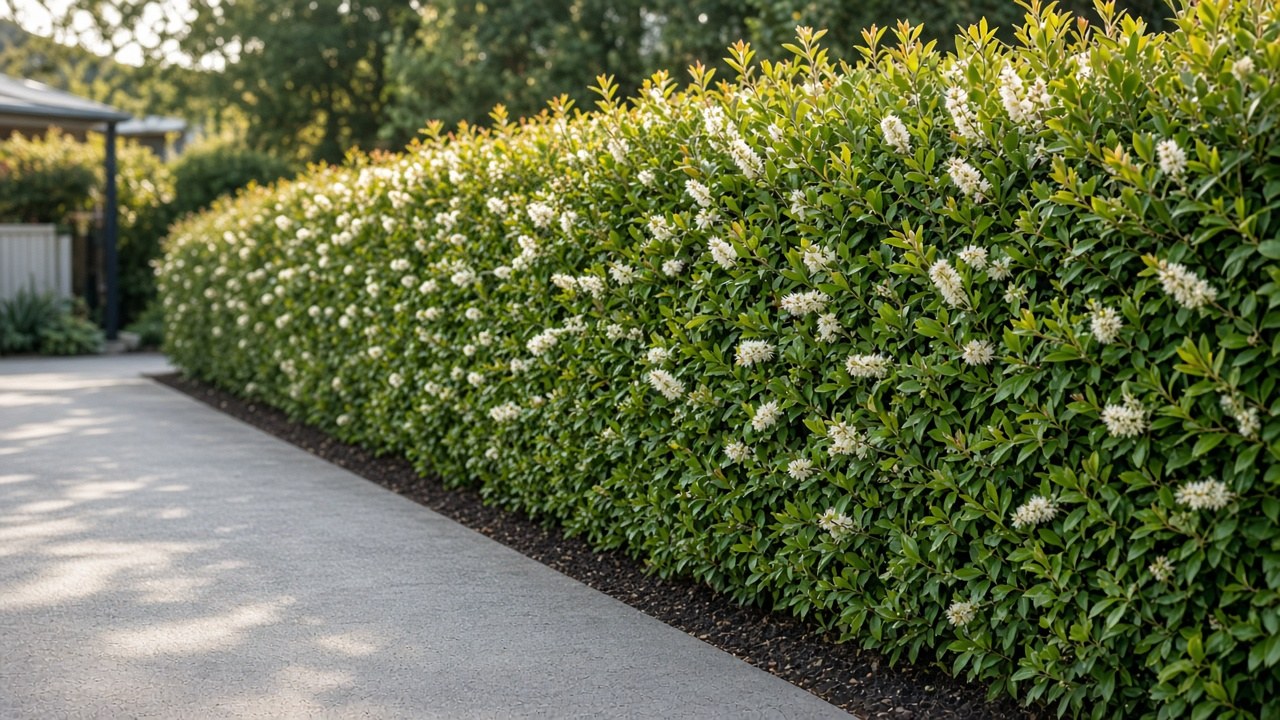
Native hedges offer Australian gardeners the best of both worlds — beautiful privacy screens that support local wildlife, tolerate drought once established, and thrive without the constant maintenance exotic hedges demand. Whether you need a tall boundary screen or a low divider, there’s a native plant perfectly suited to your needs.
Why Choose Native Plants for Hedges?
Australian native plants evolved for our climate, soils, and weather patterns. Using natives for hedges brings multiple benefits:
Water efficiency: Once established (6-12 months), most natives survive on rainfall alone in their natural climate zones.
Wildlife habitat: Native hedges attract birds, butterflies, and beneficial insects. Flowers provide nectar, dense foliage offers shelter and nesting sites.
Low maintenance: Natives adapted to Australian soils rarely need fertiliser. Most tolerate pruning well but also look great with minimal shaping.
Pest resistance: Native plants suffer fewer pest problems than exotic species. Problems that do occur are usually minor and don’t require chemical intervention.
Year-round interest: Many natives offer colourful flowers, interesting foliage texture, and attractive seed pods.
Fire-appropriateness: Choose low-flammability natives for fire-prone areas (avoid highly flammable species like tea-tree in high-risk zones).
Choosing the Right Native Hedge
Consider these factors before selecting species:
1. Purpose and height
Privacy screening (2-5m+):
- Block views from neighbours or street
- Buffer noise and wind
- Create garden rooms
Low borders and dividers (0.5-1.5m):
- Define garden beds
- Edge pathways
- Separate lawn from planting areas
Windbreaks (3-6m+):
- Protect gardens from prevailing winds
- Coastal wind protection
- Filter dust and pollution
Habitat hedges (any height):
- Prioritise bird-attracting species with berries
- Dense branching structure for nesting
- Diverse flowering times for year-round nectar
2. Sun exposure
Full sun (6+ hours direct sun):
- Most natives thrive in full sun
- Widest species selection
- Faster growth, denser foliage
Part shade (3-6 hours sun):
- Many rainforest and understorey natives adapt well
- Slower growth than full sun
- Lusher, greener foliage
Shade (under 3 hours sun):
- Limited native hedge options
- Choose shade-tolerant understorey species
- Slower growth, may be less dense
3. Climate zone
Australia’s diverse climates mean not every native suits every location:
Temperate (Sydney, Melbourne, Adelaide, Perth):
- Widest native selection
- Consider cold tolerance for inland areas
- Many coastal and inland species thrive
Subtropical (Brisbane, Gold Coast, northern NSW):
- Choose heat and humidity-tolerant species
- Many rainforest natives excel
- Avoid alpine and cold-climate species
Tropical (Darwin, far north QLD):
- Focus on tropical and subtropical natives
- High humidity and heat tolerance essential
- Wet/dry season considerations
Arid and semi-arid (inland Australia):
- Drought tolerance critical
- Choose species from similar climates
- Mulch heavily and water during establishment
Cool temperate (Canberra, Tasmania, alpine):
- Cold hardiness essential
- Avoid frost-tender tropical species
- Slower growth due to shorter growing season
4. Soil type
Sandy soils: Most coastal natives thrive (Westringia, Myoporum, Banksia). Improve with organic matter before planting.
Clay soils: Choose clay-tolerant species (Callistemon, Leptospermum). Avoid species prone to root rot. Improve drainage if soil stays waterlogged.
Loamy soils: Ideal for most natives. Widest species choice.
Alkaline soils: Avoid calcifuge species (most Proteaceae). Choose lime-tolerant natives.
Acidic soils: Most natives prefer slightly acidic to neutral. No special treatment needed.
Best Australian Native Hedge Plants
Tall screening hedges (2-5m+)
Lilly Pilly (Syzygium species)
- Height: 3-8m (varies by species and cultivar)
- Climate: Temperate to tropical
- Sun: Full sun to part shade
- Features: Dense glossy foliage, colourful new growth (red/bronze), edible berries, fast-growing
- Maintenance: Prune 2-3 times per year for formal hedge
- Best varieties: ‘Resilience’ (disease-resistant, 4-5m), ‘Select’ (psyllid-resistant, 3-4m), ‘Cascade’ (narrow form, 4-5m)
- Notes: Very popular. Watch for psyllids (pimple-like leaf bumps). Resistant varieties available. Tolerates light frost only.
Tuckeroo (Cupaniopsis anacardioides)
- Height: 4-8m (easily pruned to 3-5m)
- Climate: Subtropical to warm temperate (coastal)
- Sun: Full sun to part shade
- Features: Dense rounded canopy, bright green divided leaves, yellow flowers, orange fruit loved by birds
- Maintenance: Prune annually or leave informal
- Best for: Coastal hedges (salt-tolerant), bird attracting
- Notes: Tough and adaptable. Tolerates wind and salt spray. Slow to medium growth.
Coast Rosemary (Westringia fruticosa)
- Height: 1.5-3m
- Climate: Temperate (coast and inland)
- Sun: Full sun to light shade
- Features: Grey-green rosemary-like foliage, white flowers year-round, extremely tough
- Maintenance: Very low. Prune lightly to shape
- Best varieties: ‘Jervis Gem’ (compact), ‘Wynyabbie Gem’ (variegated)
- Best for: Coastal conditions, low-water gardens, low-maintenance hedges
- Notes: One of the toughest native hedges. Handles wind, salt, drought, and neglect. Fast-growing.
Callistemon (Callistemon/Melaleuca species) — Bottlebrush
- Height: 2-5m (varies by species)
- Climate: Temperate, subtropical, tropical (most of Australia)
- Sun: Full sun
- Features: Red, pink, or cream bottlebrush flowers, attracts honeyeaters and lorikeets
- Maintenance: Prune after flowering
- Best varieties: Callistemon viminalis ‘Captain Cook’ (compact 2-3m), C. ‘Kings Park Special’ (dense, red flowers, 3m)
- Best for: Bird-attracting hedges, clay soils
- Notes: Handles wet and dry conditions. Very hardy. Flowers bring life to hedge.
Acmena smithii (Lilly Pilly)
- Height: 3-5m (pruned) to 10m+ (unpruned)
- Climate: Subtropical to warm temperate
- Sun: Full sun to part shade
- Features: Dense, fast-growing, glossy leaves, white fluffy flowers, purple-pink berries
- Maintenance: Prune 2-4 times per year for tight formal hedge
- Best varieties: ‘Allyn Magic’ (dense, psyllid-resistant)
- Best for: Fast-growing privacy screens, bird habitat
- Notes: Related to Syzygium. Similar care and benefits.
Medium hedges (1.5-3m)
Native Frangipani (Hymenosporum flavum)
- Height: 3-6m (easily kept at 2-3m)
- Climate: Subtropical to warm temperate
- Sun: Full sun to part shade
- Features: Glossy dark green leaves, heavily perfumed yellow flowers in spring
- Maintenance: Prune after flowering to maintain size
- Best for: Fragrant hedges, informal screens
- Notes: Beautiful but tender. Frost-sensitive. Suits warm coastal gardens.
Coastal Tea-tree (Leptospermum laevigatum)
- Height: 3-5m (naturally shrubby, can be pruned lower)
- Climate: Temperate (coastal)
- Sun: Full sun
- Features: Grey-green foliage, white flowers, extremely wind and salt tolerant
- Maintenance: Low. Prune to shape
- Best for: Coastal windbreaks, beachfront properties
- Notes: Tough as nails in coastal conditions. Fast-growing. Can become untidy without occasional pruning.
Grevillea (Grevillea species — various)
- Height: 1-4m (species-dependent)
- Climate: Most of Australia (choose local or climate-matched species)
- Sun: Full sun
- Features: Diverse flower colours and shapes, bird-attracting, drought-tolerant
- Maintenance: Prune lightly after flowering
- Best varieties: G. ‘Robyn Gordon’ (red flowers, 1.5m), G. rosmarinifolia (pink/red, 2m), G. ‘Moonlight’ (cream, 3m)
- Best for: Low-water gardens, bird habitat
- Notes: Avoid phosphorus fertilisers (most Grevilleas sensitive). Well-drained soil essential.
Native Laurel (Pittosporum undulatum)
- Height: 3-8m (prune to 2-4m)
- Climate: Temperate, subtropical
- Sun: Full sun to full shade
- Features: Glossy wavy-edged leaves, fragrant cream flowers, shade-tolerant
- Maintenance: Prune annually to control size and shape
- Best for: Shade hedges, quick screens
- Notes: Fast-growing. Can become weedy in some regions (check local status). Very adaptable.
Low hedges and borders (0.5-1.5m)
Dwarf Lilly Pilly (Syzygium ‘Tiny Trev’ or similar dwarfs)
- Height: 0.5-1m
- Climate: Temperate to subtropical
- Sun: Full sun to part shade
- Features: Dense, compact, colourful new growth
- Maintenance: Prune 2-3 times per year
- Best for: Low borders, edging paths
- Notes: Dwarf form of popular Lilly Pilly. Same care, smaller package.
Correa (Correa species)
- Height: 0.5-2m (species-dependent)
- Climate: Temperate
- Sun: Full sun to part shade
- Features: Bell-shaped flowers (red, pink, cream, green) in winter, attracts birds
- Maintenance: Very low. Light prune after flowering
- Best varieties: C. reflexa (red bells, 1m), C. alba (white bells, 1.5m)
- Best for: Low-maintenance borders, winter interest
- Notes: Hardy and drought-tolerant once established. Flowers in winter (nectar for birds when food scarce).
Native Mint Bush (Prostanthera species)
- Height: 0.5-3m (species-dependent)
- Climate: Temperate
- Sun: Full sun to light shade
- Features: Aromatic foliage (mint-like scent), masses of small flowers in spring
- Maintenance: Prune after flowering to maintain shape
- Best varieties: P. ovalifolia (purple, 2m), P. rotundifolia (purple-blue, 1-2m)
- Best for: Fragrant borders, cottage gardens
- Notes: Well-drained soil essential. Avoid heavy clay. Short-lived (5-10 years) but beautiful.
Dwarf Westringia (Westringia ‘Wynyabbie Gem’ or ‘Smokie’*)
- Height: 0.5-1m
- Climate: Temperate
- Sun: Full sun
- Features: Compact form of Coast Rosemary, same toughness
- Maintenance: Very low
- Best for: Low borders, coastal gardens, drought-tolerant edging
- Notes: All the virtues of full-sized Westringia in dwarf package.
Planting and Establishment
Site preparation
- Clear weeds thoroughly: Weeds compete with new plants for water and nutrients
- Improve soil (if needed):
- Sandy soil: Add compost or well-rotted manure (dig in 5-10cm layer)
- Clay soil: Add gypsum and compost to improve drainage and structure
- Compacted soil: Deep-dig or use raised mounds for hedge
- Mark hedge line: Use string line for straight hedge. Measure spacing evenly.
Spacing
Proper spacing prevents gaps and overcrowding:
Formal tight hedges: Space plants at 50-75% of mature width (e.g., plant rated 1.5m wide → space 75cm-1m apart)
Informal screens: Space at 75-100% of mature width (allows individual plant form to show)
Fast fill vs long-term health: Closer spacing fills faster but may require thinning later. Wider spacing takes longer to fill but plants remain healthy long-term.
Example spacing:
- Lilly Pilly ‘Resilience’ (mature width 2m): Space 1-1.5m apart
- Westringia (mature width 1.5m): Space 1-1.2m apart
- Callistemon ‘Kings Park Special’ (mature width 2m): Space 1.5m apart
Planting technique
- Dig holes: 2x width of pot, same depth as root ball
- Soak plants: Water pots thoroughly 30 minutes before planting
- Remove from pot carefully: Don’t pull by trunk. Tap bottom, slide out gently
- Tease roots: Gently loosen circling roots (critical for pot-bound plants)
- Position: Top of root ball level with ground (not buried deeper)
- Backfill: Use native soil (don’t add amendments in hole itself)
- Water in: Deep watering to settle soil and eliminate air pockets
- Mulch: 5-7cm layer of organic mulch (keep 5cm away from trunk)
Watering during establishment
First 3 months: Water 2-3 times per week (more in hot weather)
Months 3-6: Reduce to weekly (if no rain)
Months 6-12: Water every 2 weeks (dry periods only)
After 12 months: Most natives survive on rainfall in their climate zone
Method: Deep, infrequent watering encourages deep roots. Avoid frequent shallow watering.
For comprehensive guidance on creating raised garden beds with excellent drainage for hedges and other plantings, see our Australian raised garden beds guide.
Pruning and Maintenance
Initial shaping
Year 1: Prune lightly 2-3 times to encourage bushy growth from base. Remove top 10-15cm to promote lateral branching.
Year 2: Continue shaping. Hedge should be filling out nicely.
Year 3+: Hedge reaches near-mature size. Maintain with regular pruning.
Ongoing pruning
Formal hedges: Prune 2-4 times per year (spring, mid-summer, autumn, optional winter tidy)
Informal screens: Prune once per year (after flowering if applicable) or every 2-3 years for naturalistic look
Technique: Taper hedge (wider at base, narrower at top). Allows light to reach lower branches. Prevents bare bottom.
Tools: Sharp hedge shears or electric trimmer for formal hedges. Secateurs for informal pruning (more natural look).
Timing: Avoid pruning in extreme heat or cold. Best in mild weather (spring or autumn).
Fertilising
Most natives need little to no fertiliser. Over-fertilising causes problems.
When to fertilise: Only if growth is very slow or foliage pale/yellow
What to use: Native-specific slow-release fertiliser (low phosphorus). Apply in spring.
How much: Half the rate recommended on package (natives are sensitive to over-fertilising)
Alternative: Top-dress with compost annually (thin layer around base). Provides gentle nutrition.
Common Problems and Solutions
Slow growth
Causes: Poor soil, insufficient water during establishment, wrong species for climate
Solutions: Mulch well, water during dry spells first 12 months, add compost (not fertiliser) around base, ensure full sun if species needs it
Bare lower branches
Causes: Insufficient light reaching base (hedge too wide at top), inadequate initial shaping
Solutions: Prune hedge wider at base than top (taper shape), hard prune to regenerate (risky — not all species respond)
Yellowing leaves
Causes: Overwatering, poor drainage, over-fertilising, wrong soil pH (e.g., Proteaceae in alkaline soil)
Solutions: Improve drainage, reduce watering frequency, avoid fertiliser, check species soil preferences
Pests (psyllids on Lilly Pilly)
Problem: Pimple-like bumps on leaves (caused by psyllid insects)
Solutions: Choose resistant varieties (‘Resilience’, ‘Select’), hose off with water, tolerate light infestations (doesn’t kill plant), prune off badly affected leaves
Dieback
Causes: Root rot (overwatering, poor drainage), Phytophthora root rot (fungal disease)
Solutions: Improve drainage, reduce watering, remove dead plants and replace with species suited to wetter conditions, avoid planting too deep
Professional Installation and Landscaping
Installing a hedge requires careful planning, site preparation, correct plant selection, and proper spacing. For large hedges, professional installation ensures:
- Correct species selection for your soil, climate, and exposure
- Proper site preparation including drainage solutions if needed
- Quality advanced stock sized for fast impact
- Even spacing and alignment for uniform mature hedge
- Comprehensive care advice tailored to your plants
If you’re planning significant hedge installation or complete landscape screening, Peninsula Hard Yards offers professional landscaping services including native hedge design, installation, and maintenance guidance. Their team understands Australian natives and can recommend species perfectly suited to your site conditions.
Final Thoughts
Australian native hedge plants offer beauty, wildlife value, and low maintenance once established. The key to success is choosing the right species for your climate and site conditions, planting properly, and watering consistently during the first year.
Whether you need a tall privacy screen, medium divider, or low border, there’s a native plant that will thrive in your garden. Take time to select species suited to your conditions, invest in good establishment care, and you’ll enjoy a beautiful, resilient hedge for decades to come.