Lawn Fertiliser Australia: What to Use and When
Complete guide to fertilising Australian lawns. Learn about NPK ratios, best fertiliser types for buffalo, kikuyu, and couch grass, plus seasonal application timing for healthy, green turf.
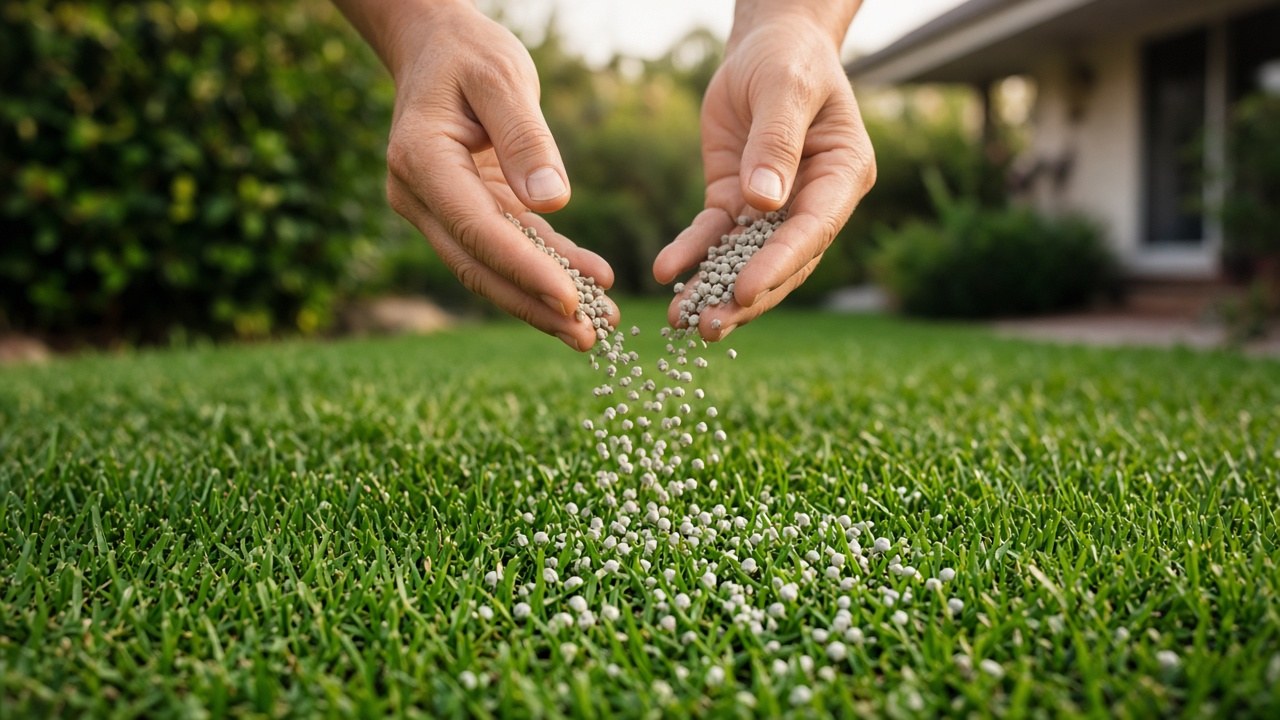
Fertilising your lawn is one of the most impactful maintenance tasks you can perform. A properly fertilised lawn grows thick and green, crowds out weeds naturally, and handles foot traffic, drought, and disease far better than an underfed lawn. But walk into any garden centre and you’ll face dozens of fertiliser products with confusing numbers, conflicting claims, and wildly different prices. Here’s what Australian lawn owners actually need to know about lawn fertiliser.
Understanding NPK: The Numbers on Every Fertiliser Bag
Every fertiliser label displays three numbers — for example, 20-5-10 or 12-3-6. These numbers represent the percentage by weight of three essential nutrients:
N - Nitrogen (first number): Promotes leaf growth and green colour. Nitrogen is the most important nutrient for lawns. It drives that lush, green appearance and encourages dense growth that crowds out weeds.
P - Phosphorus (second number): Supports root development and helps with energy transfer within the plant. Important during establishment but less critical for mature lawns.
K - Potassium (third number): Improves overall plant health, drought tolerance, disease resistance, and wear tolerance. Often called the “health and hardiness” nutrient.
What the ratios mean for your lawn
High nitrogen (e.g., 25-5-5 or 30-3-3): Best for established lawns during active growing season. Produces rapid green growth. Use spring through autumn on buffalo, kikuyu, and couch lawns.
Balanced (e.g., 12-12-12 or 15-15-15): Good for new lawns or lawns needing root development. The extra phosphorus helps establish root systems.
Slow-release or controlled-release: Nutrients release gradually over 6-12 weeks. More expensive upfront but requires fewer applications. Reduces burn risk and nutrient waste. Ideal for low-maintenance lawns.
Quick-release: Water-soluble nutrients provide immediate green-up. Cheaper but requires more frequent application (every 4-6 weeks). Higher burn risk if over-applied or not watered in properly.
Types of Lawn Fertiliser Available in Australia
Granular fertilisers
What they are: Dry pellets or granules spread across the lawn. Most common type used in Australia.
Pros:
- Easy to apply with broadcast spreader or by hand
- Long-lasting (especially slow-release formulations)
- Wide range of formulations and prices
- Can be stored for years if kept dry
Cons:
- Must be watered in immediately (risk of burn if left sitting on grass)
- Uneven application possible without spreader
- Takes 1-2 weeks to see results (slow-release types)
Best for: Most residential lawns. Regular seasonal applications.
Popular Australian brands: Lawn Solutions Premium Lawn Food, Scotts Lawn Builder, Amgrow Lawn Legend, Richgro Lawn Food, Neutrog Sudden Impact for Lawns.
Liquid fertilisers
What they are: Concentrated liquid nutrients diluted in water and applied with hose-on sprayer or watering can.
Pros:
- Fast green-up (visible results in 3-7 days)
- Even coverage (less risk of missed spots)
- Lower burn risk (already dissolved)
- Good for small lawns or spot-treatment
Cons:
- More frequent application needed (2-4 weeks)
- More expensive per application than granular
- Requires dilution and application equipment
- Can’t be applied in rain or wind
Best for: Quick green-up before events, small lawns, iron-deficient lawns (many liquid products contain iron for darker green colour).
Popular Australian brands: Lawn Soother, Yates Lawn Fertiliser Hose-On, Seasol Lawn.
Organic fertilisers
What they are: Derived from natural sources — composted manures, blood and bone, seaweed, fish emulsion, organic pellets.
Pros:
- Improves soil structure and microbial activity
- Lower burn risk
- Environmentally gentler
- Slow, steady nutrient release
- Safe for pets and kids (generally)
Cons:
- Slower results than synthetic fertilisers
- Lower nutrient concentration (need more product)
- More expensive per kilogram of nutrients
- Can smell (manure-based products)
- Variable NPK ratios
Best for: Organic gardeners, pet-safe lawns, improving poor soil, long-term lawn health.
Popular products: Blood and bone, Dynamic Lifter, eco-naturalure, cow manure pellets, Neutrog Sudden Impact Organic.
Synthetic (chemical) fertilisers
What they are: Manufactured nutrients in precise ratios. The standard choice for most Australian lawn products.
Pros:
- Precise NPK formulation
- Fast, predictable results
- Higher nutrient concentration (less product needed)
- Wide range of specialised formulations
Cons:
- Higher burn risk if misapplied
- Can leach through soil faster (environmental concerns)
- Doesn’t improve soil structure
- Salt buildup possible with heavy use
Best for: Most lawns. Reliable, effective, affordable.
Best Fertiliser for Australian Lawn Types
Buffalo grass fertiliser
Buffalo grass grows more slowly than kikuyu but still needs regular feeding to maintain density and colour. Modern buffalo varieties like Sir Walter, Palmetto, and Sapphire perform best with 3-4 applications per year.
Recommended NPK: Moderate to high nitrogen. 20-5-10, 25-5-5, or similar.
Application rate: 30-40g per square metre (check product label).
Special considerations:
- Buffalo is prone to thatch buildup, so avoid over-fertilising (excess nitrogen increases thatch)
- Iron supplements (liquid or granular with added iron) improve dark green colour without excessive growth
- Buffalo responds well to slow-release formulations
For complete buffalo care, see our Sir Walter buffalo grass guide.
Kikuyu grass fertiliser
Kikuyu is a vigorous, fast-growing grass that responds aggressively to fertiliser. It needs regular feeding during the growing season but requires careful management to avoid becoming invasive.
Recommended NPK: Moderate nitrogen (too much makes it grow uncontrollably). 15-5-10 to 20-5-10.
Application rate: 30-40g per square metre.
Special considerations:
- Kikuyu responds dramatically to nitrogen — expect to mow twice weekly after fertilising
- Potassium-rich fertilisers improve wear tolerance for high-traffic kikuyu lawns
- Consider using lower rates (20-30g/m²) if you struggle to keep up with mowing
Couch grass fertiliser
Couch grass, especially premium cultivars like TifTuf and Santa Ana, thrives with regular, balanced feeding. Couch is the heaviest feeder of the three common Australian grasses.
Recommended NPK: High nitrogen for that golf-course finish. 25-5-5 to 30-3-3.
Application rate: 40-50g per square metre (couch tolerates higher rates than buffalo or kikuyu).
Special considerations:
- Couch needs 4-5 applications per year for best results
- Iron supplements create that deep blue-green colour golf courses are known for
- Couch benefits from light, frequent feeding rather than heavy, infrequent doses
For detailed grass comparison, see our buffalo vs kikuyu vs couch guide.
When to Fertilise Lawn in Australia: Seasonal Timing
Spring (September-November)
Why: Grass is breaking dormancy and entering rapid growth phase. Spring feeding kickstarts growth and green colour recovery.
What to apply: High-nitrogen fertiliser (20-5-10 or similar). This is your most important application of the year.
Rate: Full rate (40-50g/m² for couch, 30-40g/m² for buffalo and kikuyu).
Notes: Apply after last frost when soil temperature consistently exceeds 12-14°C. Water in thoroughly. This application sets your lawn up for summer.
Summer (December-February)
Why: Peak growing season. Lawns need nutrients to maintain vigour through heat and foot traffic.
What to apply: Moderate-nitrogen fertiliser (15-5-10 or 20-5-10).
Rate: Full rate for first application (early summer), lighter rate (20-30g/m²) if applying again mid-late summer.
Notes: Avoid fertilising during extreme heat waves (35°C+) or drought stress. Water in immediately to prevent burn. If water-restricted, skip fertiliser until conditions improve.
Autumn (March-May)
Why: Grass is still actively growing but slowing down. Autumn feeding builds carbohydrate reserves for winter and improves winter colour.
What to apply: Moderate-nitrogen fertiliser with higher potassium (e.g., 15-5-15 or similar) to improve cold tolerance.
Rate: Full rate (30-40g/m²).
Notes: Apply in mid-autumn (April for most of Australia). Too late and grass won’t utilise nutrients before dormancy. This application improves winter colour and spring green-up.
Winter (June-August)
Why: Most warm-season grasses are dormant or semi-dormant. Winter fertilising is optional and regional.
What to apply: Light application of complete fertiliser or none at all.
Rate: Half rate (15-20g/m²) if applying.
Notes:
- Skip winter feeding in southern states (Melbourne, Adelaide, Tasmania, Canberra) where grass is fully dormant
- Light winter feed can maintain colour in subtropical/tropical regions (Brisbane, Gold Coast, Darwin) where grass stays semi-active
- Winter liquid feeds with iron can improve colour without stimulating growth
Recommended annual schedule
Minimum program (2 applications):
- Spring (September-October)
- Autumn (April)
Standard program (3 applications):
- Spring (September-October)
- Summer (January)
- Autumn (April)
Premium program (4+ applications):
- Early spring (September)
- Late spring (November)
- Mid-summer (January)
- Autumn (April)
- Optional light feed subtropical regions (July)
How to Apply Lawn Fertiliser Correctly
Step 1: Mow first
Mow 1-2 days before fertilising. Short grass allows granules to reach soil surface. Don’t fertilise unmowed, long grass — granules sit on leaf blades and burn foliage.
Step 2: Measure your lawn
Calculate lawn area (length × width in metres). Accurate area measurement prevents under or over-application.
Step 3: Calculate fertiliser amount
Check product label for application rate (usually 30-50g per square metre). Multiply rate by lawn area.
Example: 100m² lawn, product rate 40g/m² = 4,000g (4kg) total fertiliser needed.
Step 4: Apply evenly
With broadcast spreader (recommended for lawns >50m²):
- Fill spreader with measured amount
- Set spreader to recommended setting (check product label)
- Walk steady pace in overlapping rows (like mowing pattern)
- For even coverage, apply half the product walking north-south, other half walking east-west
By hand (small lawns only):
- Divide lawn into sections (e.g., 4 quarters for 40m² lawn)
- Divide fertiliser into equal portions (e.g., 4 portions)
- Broadcast each portion over its section
- Wear gloves
- Throw fertiliser in wide, sweeping arcs for even coverage
Step 5: Water in immediately
Critical step. Granular fertiliser sitting on grass blades will burn. Water in thoroughly within 24 hours (preferably within 1-2 hours).
How much water: 10-15mm (run sprinklers for 20-30 minutes or until you see water pooling). This washes fertiliser off blades and down to soil where roots can access it.
Don’t skip this. Even “no-burn” fertilisers should be watered in.
Step 6: Keep traffic off for 24 hours
Allow fertiliser to settle and wash into soil before heavy foot traffic.
Common Lawn Fertiliser Mistakes
1. Over-fertilising
Symptoms: Burnt brown patches, rapid excessive growth, lush dark green grass that collapses under foot traffic, thatch buildup, fertiliser runoff into waterways.
Solution: Always follow product label rates. More is not better. “Little and often” beats heavy, infrequent applications.
2. Under-fertilising
Symptoms: Pale green or yellow grass, thin turf, slow growth, weeds taking over, poor wear tolerance.
Solution: Fertilise at least twice per year (spring and autumn minimum). Increase to 3-4 applications if lawn is still underperforming.
3. Not watering in
Symptoms: Burnt stripes or patches where fertiliser granules sat on grass.
Solution: Water in within 24 hours. Set a reminder. Non-negotiable.
4. Fertilising stressed lawns
Problem: Fertilising during drought, extreme heat, or when grass is diseased or damaged can worsen stress and cause burn.
Solution: Only fertilise healthy, actively growing grass. If lawn is drought-stressed, water deeply first, wait a week, then fertilise.
5. Using the wrong fertiliser type
Problem: Applying new-lawn fertiliser (high phosphorus) to established lawns, or vice versa. Using summer fertiliser in autumn.
Solution: Match fertiliser type to lawn stage and season. Established lawns need high nitrogen, not high phosphorus.
6. Fertilising shade
Problem: Over-fertilising shaded areas causes soft, disease-prone growth that doesn’t get enough light to support the rapid growth nitrogen promotes.
Solution: Reduce rates by 25-50% in shaded areas, or skip fertiliser altogether if shade is severe.
Soil Testing: Is It Worth It?
For most Australian lawns, regular balanced fertiliser applications (spring, summer, autumn) are sufficient. However, soil testing can be valuable if:
- Your lawn isn’t responding to standard fertiliser
- You have persistent yellowing or poor growth despite feeding
- Your soil is coastal sand or heavy clay
- You’re establishing a new lawn
What soil tests reveal: pH level, nitrogen, phosphorus, potassium levels, trace elements, organic matter content, soil texture.
How to test:
- DIY kits ($15-30 from garden centres) — basic but useful
- Professional lab testing ($50-150) — detailed analysis and recommendations
Common Australian lawn soil issues:
- Low pH (acidic soil): Common in high-rainfall areas. Grass yellows, moss thrives. Fix with lime or dolomite.
- High pH (alkaline soil): Common in low-rainfall areas. Iron deficiency (yellow grass). Fix with iron sulfate or acidifying fertiliser.
- Compacted soil: Poor nutrient uptake. Core aerate to improve.
- Sandy soil: Nutrients leach quickly. Use slow-release fertilisers and apply lighter, more frequent doses.
- Clay soil: Retains nutrients but drains poorly. Improve with gypsum and organic matter (top-dressing).
Fertilising vs Other Lawn Care Practices
Fertilising alone won’t create a perfect lawn. It works best as part of a complete lawn care program:
Mowing: Correct height and frequency matter more than fertiliser. For guidance, see our lawn care basics.
Watering: Deep, infrequent watering (1-2 times weekly) beats frequent shallow watering. See our lawn watering guide.
Aerating: Compacted soil prevents fertiliser from reaching roots. Aerate annually in spring or autumn to improve nutrient uptake.
Dethatching: Thick thatch layers block fertiliser from reaching soil. Dethatch buffalo lawns every 1-2 years. See our lawn dethatching guide.
Weed control: Fertiliser makes weeds grow too. Control weeds before feeding, or use combination weed-and-feed products in spring.
Professional Lawn Fertilisation Services
Many Australian homeowners prefer professional lawn care services that include fertilisation as part of regular maintenance programs. Professional services offer:
- Correct seasonal timing and product selection
- Even application with commercial equipment
- Integrated weed control and pest management
- Soil testing and customised programs
- Guaranteed results
Mowing Magic provides professional lawn fertilisation and care programs across Australia. Their lawn specialists create customised seasonal fertiliser schedules for buffalo, kikuyu, and couch lawns, taking the guesswork out of lawn nutrition while ensuring your grass receives exactly what it needs, when it needs it.
Final Thoughts
Lawn fertiliser isn’t complicated once you understand the basics. Australian lawns need 3-4 applications per year — spring, summer, autumn, and optionally a light winter feed in warmer climates. Use high-nitrogen formulations (20-5-10 or similar) for established lawns, water in immediately after application, and avoid over-feeding.
For buffalo grass, focus on moderate nitrogen with added iron for colour without excessive growth. Kikuyu responds aggressively to fertiliser, so use moderate rates unless you want to mow twice weekly. Couch grass is the hungriest and responds well to frequent, lighter applications of high-nitrogen fertiliser.
The difference between a thin, weedy lawn and a thick, healthy lawn often comes down to consistent feeding. Set reminders for spring, summer, and autumn applications, use a quality slow-release fertiliser, and your lawn will reward you with improved colour, density, and resilience.