How to Top Dress a Lawn in Australia
Step-by-step guide to top dressing Australian lawns. Learn when to top dress, what materials to use, application techniques, and how top dressing improves buffalo, kikuyu, and couch lawns.
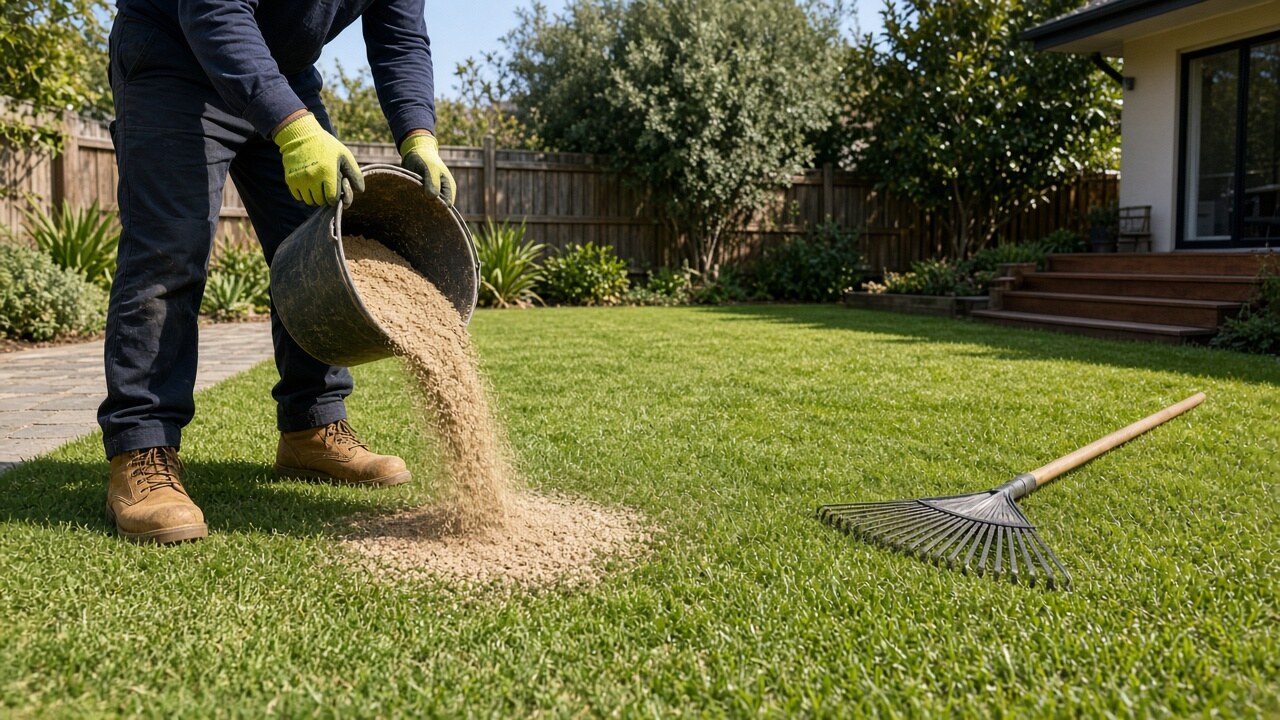
Top dressing is one of the most effective lawn renovation techniques available to Australian homeowners. By spreading a thin layer of quality soil mix over your lawn, you can level uneven surfaces, improve soil structure, reduce thatch, and encourage thick, healthy turf. Whether you’re fixing bumpy patches in your buffalo lawn, improving drainage in clay soil, or giving your couch lawn a spring boost, top dressing delivers noticeable results. Here’s how to top dress your Australian lawn correctly.
What Is Top Dressing?
Top dressing is the practice of spreading a thin layer (typically 5-10mm) of soil, sand, or compost mix over an existing lawn. The material is worked into the turf so it settles down to the soil surface, where it improves growing conditions without smothering grass.
What top dressing does
- Levels bumps and hollows: Fills low spots and evens out uneven surfaces caused by settling, foot traffic, or poor installation
- Improves soil structure: Adds organic matter to clay soils or improves moisture retention in sandy soils
- Reduces thatch: Encourages microbial breakdown of thatch layers (especially in buffalo lawns)
- Promotes root growth: Creates a better growing environment for roots
- Improves drainage: Sand-based top dressing improves water penetration in heavy soils
- Helps overseeding: Provides a good seedbed for new grass seed (less common for Australian warm-season grasses, which are typically vegetative)
What top dressing is NOT
- Not a substitute for fertiliser: Top dressing improves soil structure but doesn’t provide significant nutrients
- Not a quick fix for dead patches: Dead grass won’t regrow; you need to overseed or re-turf bare areas
- Not for smothering weeds: Top dressing alone won’t control weeds (use selective herbicides or manual removal)
When to Top Dress a Lawn in Australia
Timing is critical. Top dress when grass is actively growing so it can quickly grow through the new material.
Best time: Spring (September-November)
Why: Warm-season grasses (buffalo, kikuyu, couch) are entering peak growth. They recover quickly from the disturbance and grow through the top dressing within 2-3 weeks.
Ideal conditions: Soil temperature consistently above 12-14°C, grass actively growing, no frost risk.
Second-best time: Early autumn (March-April)
Why: Grass is still actively growing but slowing down. Gives grass 4-6 weeks to recover before winter dormancy.
Caution: Don’t top dress late autumn (May-June) — grass won’t have time to grow through before winter, and you’ll smother the lawn.
Avoid these times
Summer: Risk of heat stress. If you must top dress in summer, do it early morning or late afternoon, water heavily, and choose a mild week (not during a heatwave).
Winter: Grass is dormant and won’t grow through the top dressing. Material just sits on the surface, potentially smothering grass and encouraging fungal issues.
During drought or water restrictions: Top dressing requires heavy watering after application. If you can’t water adequately, postpone until conditions improve.
What Materials to Use for Top Dressing
The right material depends on your soil type, grass type, and goals.
Sand-based mix (70% sand, 30% compost or loam)
Best for: Clay soils, heavy soils, improving drainage.
Pros:
- Improves drainage and aeration
- Lightens heavy clay soil
- Less likely to compact
- Levels well (sand settles into low spots)
Cons:
- Adds minimal organic matter or nutrients
- Can create layering issues if used repeatedly on clay without mixing (sand layer can become a barrier)
Recommendation: Use coarse river sand or washed sand, not fine beach sand or builders’ sand (which compacts).
Loam-based mix (quality topsoil or loam with added compost)
Best for: Sandy soils needing organic matter, general-purpose top dressing.
Pros:
- Adds organic matter and nutrients
- Improves water retention in sandy soils
- Good for overall soil health
Cons:
- Can introduce weed seeds if not quality-screened topsoil
- Heavier to spread
- May compact on clay soils
Recommendation: Buy quality screened topsoil or loam, not cheap “fill dirt” which often contains clay, rocks, and weed seeds.
Compost-based mix (compost with sand or loam)
Best for: Improving soil biology, adding organic matter, reducing thatch.
Pros:
- Rich in organic matter
- Encourages beneficial microbes
- Improves soil structure long-term
- Helps break down thatch (especially buffalo lawns)
Cons:
- Too much compost can create soft, spongy turf
- Fresh compost can burn grass if not fully composted
- Can introduce weed seeds if compost isn’t hot-composted
Recommendation: Use mature, well-composted material. Blend 20-30% compost with 70-80% sand or loam.
Specialist lawn top dressing blends
What they are: Pre-mixed blends sold at garden centres and turf suppliers. Usually 70% sand, 30% organic matter (compost, peat, coir).
Pros:
- Convenient (no mixing required)
- Consistent quality
- Weed-seed free (reputable brands)
Cons:
- More expensive than DIY blends
- May not be tailored to your specific soil needs
Popular brands: Lawn Solutions Premium Top Dressing, Scotts Lawn Top Dressing, Richgro Lawn Top Dressing.
Material by grass type
Buffalo: Compost-based or balanced sand/loam/compost mix. Buffalo produces thatch, so organic matter helps break it down. For more on managing buffalo thatch, see our dethatching guide.
Kikuyu: Sand-based mix to improve drainage and prevent thatch buildup (kikuyu grows aggressively and can develop thatch on heavy soils).
Couch: Balanced sand/loam mix or specialist blend. Couch has low thatch production but benefits from levelling and improved soil structure.
Material by soil type
Clay soil: Sand-based mix (70-80% coarse sand, 20-30% compost). Improves drainage and prevents waterlogging.
Sandy soil: Loam or compost-based mix to improve water retention and add organic matter.
Loam soil (ideal): Balanced mix or specialist blend to maintain good structure.
How Much Top Dressing Do You Need?
Calculate your lawn area and decide on application depth.
Application depth
Light top dressing (5mm): Maintenance top dressing for relatively level lawns. Improves soil structure without major levelling.
Standard top dressing (7-10mm): Most common depth. Levels minor unevenness and provides good soil improvement.
Heavy top dressing (10-15mm): For lawns with significant bumps and hollows. Risk of smothhing grass if applied too thickly in one go.
Never exceed 15mm in a single application. If lawn needs more levelling, do multiple applications over 2-3 seasons.
Calculating quantity
Formula: Lawn area (m²) × depth (m) = volume (m³)
Example 1: 100m² lawn, 10mm (0.01m) depth
- 100 × 0.01 = 1 cubic metre (1m³)
Example 2: 50m² lawn, 5mm (0.005m) depth
- 50 × 0.005 = 0.25 cubic metres (250 litres)
Rule of thumb:
- 1m³ covers 100m² at 10mm depth
- 1m³ covers 200m² at 5mm depth
Bulk vs bagged:
- Bulk delivery: Order by cubic metre (cheaper for large lawns). Minimum order often 1-2m³.
- Bagged: 25-30L bags (more expensive but convenient for small lawns). You’ll need about 4 bags per 10m² at 10mm depth.
Step-by-Step: How to Top Dress Your Lawn
Step 1: Prepare the lawn
Mow short: Mow 2-3 days before top dressing. Cut grass to lowest comfortable height for your grass type (e.g., buffalo 20-25mm, couch 15-20mm, kikuyu 20-30mm). Short grass makes it easier to spread and work in top dressing.
Remove clippings: Collect clippings so they don’t create a barrier between top dressing and soil.
Dethatch if needed: If your lawn (especially buffalo) has thick thatch (>15mm), dethatch first. Top dressing over thick thatch is less effective. See our dethatching guide.
Aerate if compacted: For compacted lawns, core aerate before top dressing. Aeration holes allow top dressing to penetrate deeper and improve results. See our lawn aeration guide.
Water the day before: Lightly water lawn the day before top dressing so grass is hydrated but surface isn’t muddy.
Step 2: Apply top dressing
Dump and spread method (most common for home lawns):
-
Dump piles: Shovel or wheelbarrow top dressing onto lawn in evenly spaced piles (e.g., one pile every 2-3m²).
-
Spread with back of rake or levelling tool: Use a landscaping rake, level rake, or drag mat to spread top dressing evenly. Work in long, smooth strokes to achieve consistent 5-10mm layer.
-
Check depth: Grass blades should still be visible. If grass is completely buried, you’ve applied too much — rake excess away.
Tip: For small lawns (<50m²), use a garden rake or stiff broom. For larger lawns (>100m²), consider a levelling rake or drag mat.
Mechanical spreader method (for large lawns or professional use):
- Top dressing spreaders (pull-behind or walk-behind) apply material more evenly and quickly
- Rental available at some equipment hire shops
- Best for lawns >200m²
Step 3: Work top dressing into turf
Once spread, you need to work the material down to the soil surface so it settles between grass blades rather than sitting on top.
Tools:
- Stiff broom or push broom: Brush in multiple directions to work material down
- Back of rake: Use light sweeping motion
- Drag mat: Pull mat over lawn to distribute and settle material
- Feet: Walk over lawn to help material settle (not necessary but doesn’t hurt)
Goal: Grass blades should stick up through the top dressing. Material should settle around the base of plants, not bury them.
Step 4: Water in thoroughly
Critical step: Water heavily immediately after top dressing.
Why: Watering settles the material, prevents it from drying out and blowing away, and washes any material off grass blades (reducing burn risk).
How much: 10-20mm of water (run sprinklers for 30-60 minutes depending on sprinkler output). You want the top dressing thoroughly wet and settled, not just damp.
Frequency: Keep top dressing moist (but not waterlogged) for the first week. Water daily or every second day depending on weather.
Step 5: Fertilise (optional but recommended)
Applying fertiliser 7-10 days after top dressing encourages rapid grass growth through the new material.
What to use: Complete lawn fertiliser with high nitrogen (e.g., 20-5-10 or similar). Slow-release formulation preferred.
Application rate: Follow product label (typically 30-40g per m²).
Water in: Water fertiliser in immediately after application.
For detailed fertiliser guidance, see our lawn fertiliser guide.
Step 6: Avoid heavy traffic
Keep foot traffic light for 2-3 weeks while grass grows through the top dressing. Heavy traffic can displace material before it settles properly.
Levelling Specific Low Spots (Localised Top Dressing)
If you only have a few low spots or bumps rather than needing to top dress the whole lawn, you can spot-level.
For shallow depressions (10-20mm deep)
- Fill with top dressing mix, slightly overfilling
- Work material in with rake or broom
- Water thoroughly
- Repeat in 6-8 weeks if settling occurs
For deeper depressions (>20mm)
Don’t try to fill in one go — you’ll smother grass.
Method:
- Apply 10mm top dressing and work in
- Wait 6-8 weeks for grass to grow through
- Apply another 10mm layer
- Repeat until level (may take 2-3 applications over multiple seasons)
For raised bumps
Option 1: Top dress surrounding area to match bump height (works for minor bumps).
Option 2: Remove turf, level soil below, and relay turf (best for significant bumps).
Common Top Dressing Mistakes
1. Applying too thick
Problem: Burying grass blades prevents photosynthesis. Grass yellows, weakens, or dies.
Solution: Never exceed 15mm in one application. Grass blades should be visible through the top dressing.
2. Top dressing at the wrong time
Problem: Top dressing in winter or during dormancy smothers grass that isn’t actively growing.
Solution: Only top dress during active growth (spring or early autumn for Australian warm-season grasses).
3. Not watering in
Problem: Dry top dressing blows away, doesn’t settle, or burns grass.
Solution: Water heavily immediately after application and keep moist for first week.
4. Using poor-quality material
Problem: Cheap “fill dirt” or unscreened soil introduces weeds, rocks, and clay clumps.
Solution: Buy quality screened topsoil, purpose-made lawn top dressing blend, or make your own with washed sand and quality compost.
5. Skipping preparation
Problem: Top dressing over thick thatch or without mowing results in poor contact with soil.
Solution: Mow short, dethatch if needed, and aerate compacted lawns before top dressing.
6. Not working material in
Problem: Top dressing sitting on surface rather than settling down to soil doesn’t improve structure or level effectively.
Solution: Use rake or broom to work material down between grass blades.
7. Overloading clay soil with sand
Problem: Repeatedly applying pure sand to clay soil without mixing can create a layered “sand over clay” profile that impedes water movement.
Solution: Mix sand with organic matter (compost), or till sand into clay before laying turf. For established lawns, use balanced sand/compost blends rather than pure sand.
How Often Should You Top Dress?
Annual top dressing (every year): For high-maintenance lawns or lawns on poor soil. Maintains level surface and gradually improves soil structure.
Every 2-3 years (most common): Standard approach for typical residential lawns. Provides noticeable improvement without excessive work or cost.
As-needed basis: Top dress when lawn becomes uneven, after aeration, or when renovating neglected lawns.
Buffalo lawns: Consider annual or biennial top dressing to help manage thatch buildup.
Couch/kikuyu lawns: Every 2-3 years sufficient unless you’re actively levelling or improving poor soil.
Professional Top Dressing Services
Top dressing a large lawn (>200m²) is labour-intensive. Professional lawn care services have access to mechanical spreaders, bulk materials, and experience to ensure even application and excellent results.
Professional services typically include:
- Lawn assessment and soil testing
- Pre-mowing and preparation (aeration, dethatching if needed)
- Quality top dressing blend selection
- Even mechanical application
- Post-dressing fertilisation
- Watering advice
Mowing Magic provides professional lawn top dressing services across Australia as part of comprehensive lawn renovation programs. Their specialists assess your lawn’s needs, select the right material blend, and apply top dressing evenly for lasting results. Combined with aeration, dethatching, and fertilisation, professional top dressing transforms tired, uneven lawns into lush, level turf.
Top Dressing as Part of Lawn Renovation
Top dressing delivers best results when combined with other renovation techniques:
Renovation sequence:
- Mow short (scalp if needed)
- Dethatch if thatch layer >15mm (see our dethatching guide)
- Aerate for compacted soil (see our aeration guide)
- Apply top dressing (5-10mm)
- Work in with rake or broom
- Water heavily immediately
- Fertilise 7-10 days later (see our fertiliser guide)
- Maintain with regular mowing and watering
This complete renovation approach transforms neglected or poor-performing lawns in a single season.
Final Thoughts
Top dressing is one of the most effective lawn care practices available to Australian homeowners. It levels uneven surfaces, improves soil structure, reduces thatch, and encourages dense, healthy turf without the disruption of completely renovating or replacing your lawn.
The key to successful top dressing is timing (spring or early autumn when grass is actively growing), using quality materials (sand/loam/compost blends appropriate for your soil), applying thin layers (5-10mm maximum), working the material into the turf, and watering heavily immediately after application.
For buffalo lawns prone to thatch buildup, regular top dressing with compost-enriched blends helps break down organic matter and maintains a healthy surface. For couch and kikuyu lawns on clay soils, sand-based blends improve drainage and prevent waterlogging.
Top dress your lawn every 2-3 years as general maintenance, or annually if you’re working to correct significant unevenness or improve poor soil. Combine top dressing with aeration, dethatching, and fertilisation for maximum impact, and your lawn will reward you with improved appearance, better drainage, and healthier, more resilient turf.